



Introduction
The narrative of Kuwait’s economic history is often dominated by a single, powerful protagonist: oil. Since the discovery of vast hydrocarbon reserves in the mid-20th century, this small Gulf nation transformed from a modest trading and pearl-diving community into one of the world’s wealthiest countries per capita. However, this rapid modernization created a unique demographic landscape—a highly urbanized state where most of the population resides in a concentrated area along the Persian Gulf coast.
Today, as Kuwait actively pursues “Vision 2035” (New Kuwait)—a strategic plan designed to transform the country into a regional financial and commercial hub and reduce oil dependency—the spotlight is shifting from the oil fields to the cities. In modern economies, cities are more than just places to live; they are dense nodes of human capital, innovation, and commerce.1 They act as the crucibles where services are delivered, capital is managed, and new industries are born.2
The economic future of Kuwait is intrinsically linked to the performance and specialization of its major urban centers. While they all operate under the national umbrella, different cities have developed distinct economic identities that contribute to the country’s overall stability and diversification efforts. By examining the top five urban areas—Kuwait City, Hawally, Salmiya, Farwaniya, and Jahra—we can understand how this synergy of urban centers drives the nation forward.
The Urban Economic Engine: A Macro View
Before delving into specific cities, it is crucial to understand the general economic role played by urban areas in a country like Kuwait. Economists refer to this as “agglomeration economies.” When businesses and people cluster together in cities, efficiency increases.3 Companies have better access to a specialized labor pool, suppliers are located nearby, and knowledge “spills over” between firms, fostering innovation.
In Kuwait’s context, the urban centers are the primary vehicle for diversification away from the hydrocarbon sector. While oil revenues fund the state, the non-oil economy—comprising finance, retail, real estate, logistics, and technology—happens almost exclusively within these city limits.
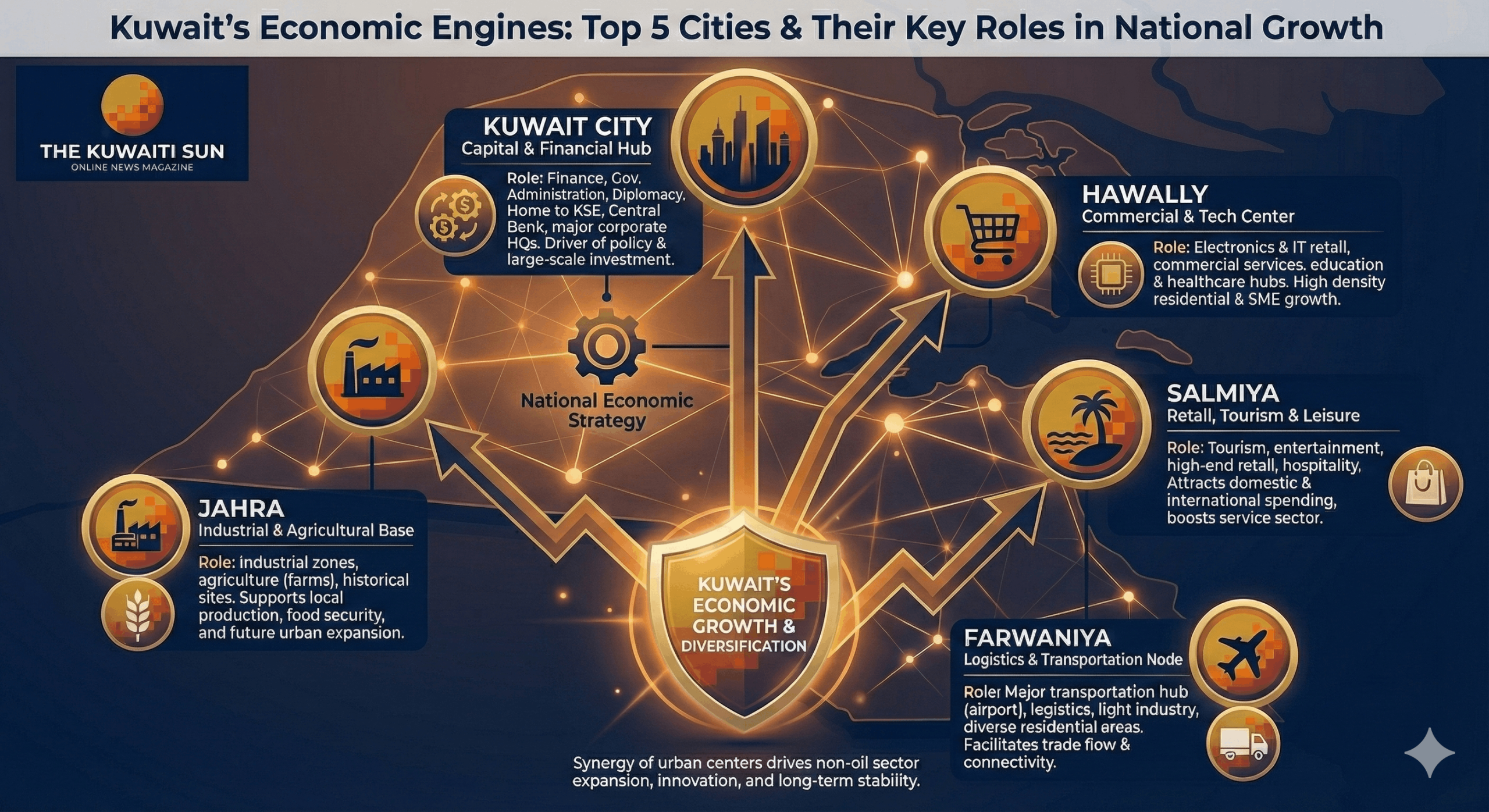
As illustrated in the accompanying infographic, “Kuwait’s Economic Engines,” these cities do not operate in isolation. They are connected by infrastructure and policy, all feeding into a central goal: national economic growth and diversification. The central shield in the infographic represents this unified objective, highlighting that the synergy between these distinct urban roles is what ultimately drives long-term stability and innovation. The national economic strategy acts as the central gear, coordinating the distinct functions of each city to maximize national output.
The Top Five Cities: Pillars of the Kuwaiti Economy
Kuwait’s urban landscape is dominated by the sprawling Metropolitan Area. Within and around this area, five distinct nodes stand out for their population density, economic activity, and strategic importance.
- Kuwait City: The Capital and Financial Nerve Center
Kuwait City is the undisputed political and economic heart of the nation. It is the “brain” of the country’s operations. As indicated in the infographic, its primary roles are centered on finance, government administration, and diplomacy.
Economically, Kuwait City is the hub of high-value services. It is home to the Kuwait Stock Exchange (Boursa Kuwait), the Central Bank of Kuwait, and the headquarters of major domestic and international banks. This is where monetary policy is implemented and where major investment decisions that shape the nation’s future are made. The iconic skyline, represented in the infographic, houses the corporate headquarters of the country’s largest conglomerates and investment firms.
Furthermore, as the seat of government, the city hosts ministries, embassies, and the National Assembly. The public sector remains the largest employer of Kuwaiti nationals, and the administrative machinery located here drives significant economic consumption. The concentration of high-income professionals in finance and government also sustains a premium real estate and high-end service market within the capital’s vicinity.
- Hawally: The Commercial and Tech Densifier
Located just south of the capital, Hawally is famous for being one of the most densely populated districts in Kuwait.9 Its economic contribution is rooted in this density, acting as a vibrant commercial and residential hub.
Hawally serves as a critical engine for the SME (Small and Medium Enterprise) sector. The infographic highlights its role as a “Commercial & Tech Center.” It is renowned across the country for its high concentration of electronics retailers, computer shops, and IT service providers. If Kuwait City is where finance is managed, Hawally is where technology is traded and serviced on the ground level.
Beyond tech, Hawally’s immense population density creates massive demand for essential services. It is a major hub for healthcare clinics, private education institutions, and mid-range retail. The district houses a large expatriate population, which provides the essential labor force for many sectors of the Kuwaiti economy. The economic velocity in Hawally is high, driven by daily commerce, residential real estate rentals, and a thriving entrepreneurial spirit in the retail sector.
- Salmiya: Retail, Tourism, and Leisure Hub
Stretching along the coastline, Salmiya is the “lifestyle” capital of Kuwait. Its economic role is pivoted toward capturing disposable income through retail, entertainment, and hospitality.
As depicted in the infographic with icons of leisure and shopping, Salmiya is central to Kuwait’s efforts to boost domestic tourism and keep consumer spending within the country. It features major shopping malls, high-street retail chains, restaurants, and hotels.11 The famous Arabian Gulf Street (the Corniche) runs through Salmiya, offering recreational spaces that attract residents from across the country, particularly on weekends.
The economic importance of Salmiya lies in its ability to stimulate the service sector. It is a primary location for international brands entering the Kuwaiti market. By providing high-end entertainment and leisure options, Salmiya enhances the quality of life, which is essential for attracting and retaining global talent, while simultaneously generating significant revenue through retail sales tax (should they be implemented in the future) and commercial rents.
- Farwaniya: The Logistics and Transportation Node
Farwaniya plays a functional, muscular role in the Kuwaiti economy. As the most populous governorate, its economic identity is deeply tied to logistics, transportation, and housing for a vast segment of the workforce.
The primary economic asset defining Farwaniya’s role is the Kuwait International Airport. As indicated by the airplane and truck icons in the infographic, this makes Farwaniya the central node for connectivity. The airport is not just for passengers; it is the primary hub for air cargo, vital for a country that imports most of its consumption goods.
Surrounding the airport and major highways, Farwaniya hosts numerous logistics companies, warehousing facilities, and light industrial workshops. It facilitates the trade flow essential for the retail sectors in Salmiya and Hawally to function. Furthermore, Farwaniya provides diverse residential areas that house a significant portion of the private sector labor force, making it indispensable to the daily operation of the national economy.
- Jahra: The Industrial and Agricultural Base
Located to the west of the main metropolitan area, Jahra historically served as an agricultural oasis. Today, it maintains that legacy while evolving into a crucial industrial base, providing a necessary counterbalance to the service-oriented coastal cities.
Jahra’s role, as highlighted in the infographic, centers on industrial zones and agriculture. It is home to significant farmland that contributes to Kuwait’s food security strategy—a vital concern for an arid nation. Furthermore, Jahra and its surrounding areas host industrial zones that are essential for manufacturing, construction materials, and other heavy industries that require space away from dense urban centers.16
Jahra also holds potential for future urban expansion. As the metropolitan area faces congestion, the western regions around Jahra offer land for new residential developments and industrial projects, supporting the long-term infrastructure needs of Vision 2035.
Synergy and Future Outlook
The economic strength of Kuwait does not rely on one single city, but rather on the interdependence of these five urban centers. The financial decisions made in Kuwait City finance the imports that arrive via Farwaniya’s logistics hub, which are then sold in the retail centers of Salmiya and electronics shops of Hawally, while Jahra provides essential industrial support and food resources.
The infographic emphasizes this “synergy of urban centers.” For Kuwait to successfully diversify its economy, this synergy must be optimized. Investments in infrastructure that link these cities—such as improved public transport networks and digital infrastructure—are crucial to reducing friction and increasing economic efficiency.
As Kuwait moves toward 2035, the roles of these cities will evolve. Hawally may become a hub for digital startups, Jahra for advanced agritech, and Kuwait City for fintech. Recognizing and nurturing the distinct economic DNA of each city is the key to unlocking a sustainable, non-oil future for the nation.
This article, Beyond the Oil Fields: How Kuwait’s Urban Centers act as the Engines of National Economic Growth, is edited, published and distributed by Arab Newswire — part of GroupWeb Media Network. To reach a target audience with press release distribution in Kuwait, the GCC/MENA region or the Arab World, please, contact us at WhatsApp or Telegram.